


The Handmaid’s Tale by Margaret Atwood is a futuristic dystopian novel, falling under the genre of speculative fiction. Written in 1985, the story takes place around the early 2000s. In this novel the birth rates have gone down a significant and concerning amount, and a conservative religious group overthrow the government and set up a regime in which women lose all the rights that they’ve gained in the 20th century, and even face absurd restrictions such as not being allowed to read. Throughout the novel women face intense oppression and must continue to live their day to day lives as if the regime has become normal, otherwise they face becoming heretics and sentenced to death or torture.
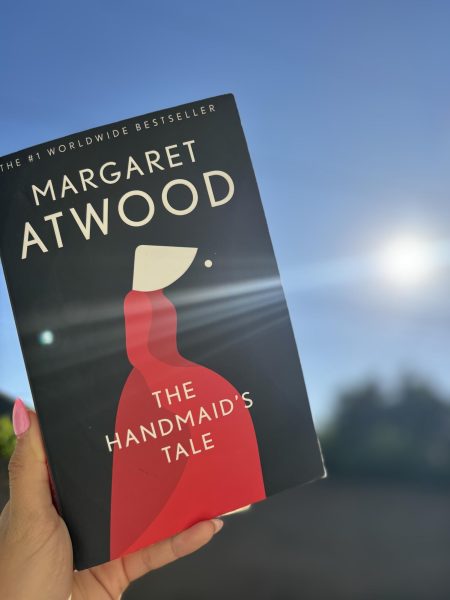
There are 7 categories that women could be placed into. Wives: These are the women married to Commanders, men who hold high ranking positions. They are allowed to try to have their own children or they will be assigned a Handmaid. Econowives: These are the wives of the lower class men. They do the jobs of Marthas and Wives, meaning they will cook, clean, and fulfill their wifely duties including producing offspring. Marthas: These women are essentially maids, they do the cooking and the cleaning of every upper class household. Handmaids: These are women who are historically fertile women. They are assigned to a high ranking family and once a month during ovulation, they are to become impregnated by their commander. Aunts: These are the only women who are granted some privileges. They are the women who train and keep track of the Handmaids. Unwomen and Jezebels: If a woman refuses to be a handmaid, she has the choice of being sent to the colonies to work until she dies from radioactive poisoning, or she can become a prostitute for a few years.
The novel focuses on one Handmaid in specific, Offred, who is assigned to a very high ranking and powerful commander. The novel follows her struggles with surviving, and the challenges of preserving her own identity while the regime around her strips all women of any individuality.
This novel has been banned and challenged all over the country for decades, but it is taught as a part of the 10th grade Honors English curriculum at Downey High School. Some of the reasons for being banned and challenged are sexual content and profanity, anti-christian themes, dystopian/controversial material, and political ideology. The teachers who teach this novel at Downey High school are Mrs. Bean and Mrs. Carlson, who added this book to the curriculum around the time it surged in popularity in the late 2010s. “I wanna say 2018 or 2017. You know it’s kind of funny. First of all, find me an English teacher who doesn’t wanna teach this book, it’s a really good book. We had come up against some books that we felt weren’t challenging enough. It was sort of a process of elimination, it was already on the approved list, but most teachers shied away from it because I think it is a little bit of a risk,” said Mrs. Bean, Honors English 10 teacher in S-23. “The Handmaid’s Tale is both challenging in terms of its language and its purpose, so it was a long process of talking and doing research. It’s been challenged around the country as a banned book, but our district has always been very receptive if the intent and the good will are there. There is no attempt at converting people into seeing the world in a certain way, but only to challenging the ideas that are in existence.”
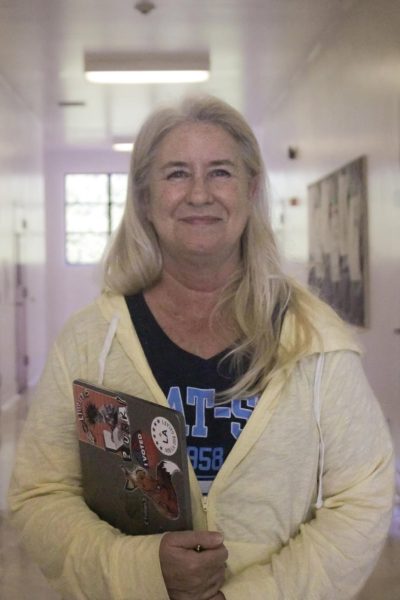
In room 26 of S building on 25 March, Mrs. Bean interviews on The Handmaid’s Tale, an impactful part of literature. Bean states, “I continue to bring up the fact that she was writing it during the Iranian revolution in the 1970s because it isn’t about christianity, it’s about any good thing twisted”. The Handmaid’s Tale is a speculative fiction novel that displays what could come of society if fertility rates were to drop, utilizing manipulated religious ideals to contribute to the Republic of Gilead, which offers an abnormal answer to this issue.
Margaret Atwood uses language that illustrates Offred’s experiences as a Handmaid and gives insight to her inner thoughts. Throughout the novel Offred offers her reflections of her current situation and her life before Gilead, giving a clear window into how severely the Giladean regime objectifies women, especially Handmaids. “I can hear it in her thinking moments, when she’s napping, when she’s alone in her room. I think when she talks about feeling like a piece of toast, buttered, and lying on her bed. I think that epitomizes the idea of a woman being made into an object. She’s had to participate. That butter she’s referring to is that pad of butter that she steals to use as lotion, but it makes her seem like such an object. I think the moments that are, to me, most furthering in her characterization are the ones where she is reflecting on what an object she is.”
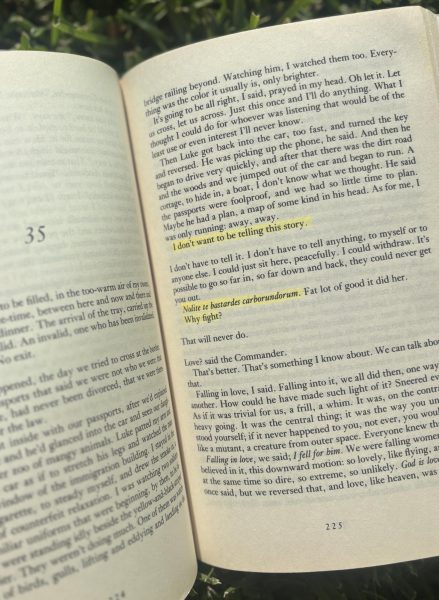
Students also enjoy the book and the experience of reading it. Santiago Andrade, 10, appreciates the irony and dark humor displayed throughout the novel most of all. An example of the dark humor scattered throughout the novel is a Latin etching in the wall of Offred’s closet. The etching reads, “Nolite te bastardes carborundorum”, and it was left by the previous Handmaid who served Offred’s commander.
“I think my favorite part of the book was when Offred asks the commander about the phrase that she found in the closest, then when the commander tells her what it means, don’t let the bastards grind you down, and he thought it was so insignificant but to me it was kind of ironic because it’s kind of what happens in Gilead, so that moment kind of stuck with me.”

Outside of the S building on March 26, Santiago Andrade shares some of his opinions on The Handmaid’s Tale from his experience in Honors 10. Andrade states, “It makes you realize how dark our history is and it also allows us to reconsider what we’ve done in the past”. The Handmaid’s Tale is a rather provocative and controversial book, however, Atwood based the most grotesque events from ones throughout history, suggesting a hidden truth about modern day life..
It’s important that we as a society read books like these to expand our perspectives on controversial topics. All of The Handmaid’s Tale is based on events that have happened in real life history. Not a single event came from Atwood’s imagination. “ I don’t want to just have people who think like I do. I want to have all different people, and if they walk away saying, well it’s not offensive, then maybe that’s a step towards opening the door to thinking about why we think the way we think.” Over the last few decades, speculative fiction books have been repeatedly targeted and challenged in the United States. The state of California enacted a law that banned book bans in public schools, however some titles, including The Handmaid’s Tale, are banned in California prisons. Overall, the state of California is very anti-censorship of most types of media, allowing most books to be integrated into school curriculums, with districts having the power to approve or disapprove books being taught in their schools.
Margaret Atwood, although Canadian, had a significant impact on American literature. The Handmaid’s Tale is often placed in the same category of books with a profound societal impact like 1984, Brave New World, and Fahrenheit 451. “I pale to what Atwood offers, so I let her speak for herself, she probably doesn’t need people like me chiming in with our two cents. She is inspiring, amongst so many. Ray Bradbury’s of the world, the people who look at our past and almost foretell our future, or tragically foretell our future.”
